
Introduction to Graphs
📊 Introduction to Graphs
Section titled “📊 Introduction to Graphs”A comprehensive overview of graphs — what they are, key terminologies, and the different types you’ll encounter in interviews.
What is a Graph?
Section titled “What is a Graph?”A graph is a non-linear data structure consisting of a set of vertices (nodes) connected by edges (links). Unlike trees (which are a special type of graph), graphs can have cycles, disconnected components, and edges pointing in any direction.
Simple Example:
    (A)-----(B)     |     / |     |    /  |     |   /   |    (C)-----(D)         |        (E)
Vertices: A, B, C, D, EEdges: A-B, A-C, B-C, B-D, C-D, C-E
Key Terminologies
Section titled “Key Terminologies”| Term | Definition | Real-World Example |
|---|---|---|
| Vertex (Node) | A fundamental unit/point in a graph | Cities on a map |
| Edge | A connection between two vertices | Roads between cities |
| Degree | Number of edges connected to a vertex | City with 3 roads → degree 3 |
| In-Degree | Edges coming INTO a vertex (directed) | Twitter followers |
| Out-Degree | Edges going OUT of a vertex (directed) | Twitter following |
| Path | A sequence of vertices connected by edges | Route from A to E |
| Simple Path | A path with no repeated vertices | Direct route, no backtracking |
| Cycle | A path that starts and ends at the same vertex | A → B → C → A |
| Self-Loop | An edge from a vertex to itself | A → A |
| Neighbor | Vertex directly connected by an edge | Adjacent cities |
| Connected | Every vertex reachable from every other vertex | One continent |
| Component | A maximal connected subgraph | Islands in a sea |
| Weight | A value/cost assigned to an edge | Distance in kilometers |
Types of Graphs
Section titled “Types of Graphs”1. Directed vs Undirected
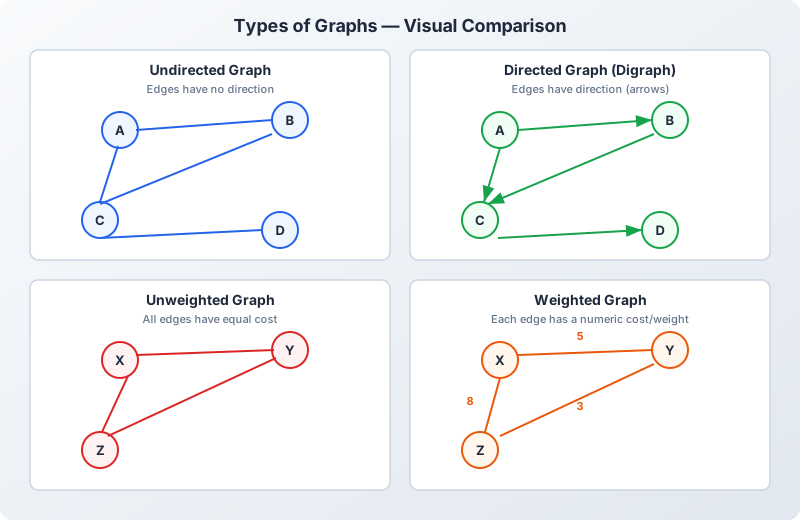
Section titled “1. Directed vs Undirected”| Undirected | Directed (Digraph) |
|---|---|
| Edges have no direction — A-B means both A→B and B→A | Edges have direction (arrows) — A→B does NOT imply B→A |
| Used for: social networks (friendships), road networks | Used for: web pages (hyperlinks), Twitter follows |
flowchart LR    subgraph Undirected        A1((A)) --- B1((B))        A1 --- C1((C))        B1 --- D1((D))        C1 --- D1    end    subgraph Directed        A2((A)) --> B2((B))        A2 --> C2((C))        C2 --> D2((D))        B2 --> D2    end
    style Undirected fill:#1e293b,color:#fff    style Directed fill:#1e293b,color:#fff
Undirected: Directed: A --- B A ---> B | | | | C --- D v v C <--- D2. Weighted vs Unweighted
Section titled “2. Weighted vs Unweighted”| Unweighted | Weighted |
|---|---|
| All edges are equal | Each edge has a numeric cost/weight |
| Used for: hop count, simple connectivity | Used for: shortest path (distance, time, cost) |
flowchart LR    subgraph Unweighted        A1((A)) --- B1((B))        A1 --- C1((C))        B1 --- D1((D))        C1 --- D1    end    subgraph Weighted        A2((A)) -- 5 --- B2((B))        A2 -- 10 --- C2((C))        B2 -- 3 --- D2((D))        C2 -- 7 --- D2    end
    style Unweighted fill:#1e293b,color:#fff    style Weighted fill:#1e293b,color:#fff
Unweighted: Weighted: A --- B A --5-- B | | | | C --- D 10 3 | | C --7-- D3. Cyclic vs Acyclic
Section titled “3. Cyclic vs Acyclic”| Cyclic | Acyclic (DAG) |
|---|---|
| Contains at least one cycle | No cycle possible |
| Used for: detecting deadlocks | Used for: task scheduling, build systems |
flowchart LR    subgraph Cyclic        A1((A)) --> B1((B))        B1 --> C1((C))        C1 --> D1((D))        D1 --> A1    end    subgraph DAG[Acyclic (DAG)]        A2((A)) --> B2((B))        A2 --> C2((C))        B2 --> D2((D))        C2 --> D2        D2 --> E2((E))    end
    style Cyclic fill:#1e293b,color:#fff    style DAG fill:#1e293b,color:#fff
Cyclic: Acyclic (DAG): A → B A → B ↑ ↓ ↓ ↓ D ← C C D ↓ E4. Connected vs Disconnected
Section titled “4. Connected vs Disconnected”| Connected | Disconnected |
|---|---|
| All nodes reachable from every other node | Some nodes are isolated (multiple components) |
flowchart LR    subgraph Connected        A1((A)) --- B1((B))        A1 --- C1((C))        B1 --- D1((D))        C1 --- D1    end    subgraph Disconnected        A2((A)) --- B2((B))        D2((D)) --- E2((E))        D2 --- F2((F))    end
    style Connected fill:#1e293b,color:#fff    style Disconnected fill:#1e293b,color:#fff
Connected: Disconnected: A --- B A --- B D --- E | | | C --- D F5. Special Graph Types
Section titled “5. Special Graph Types”| Type | Description | Edges |
|---|---|---|
| Tree | Connected, acyclic, undirected | N-1 edges for N nodes |
| Forest | Collection of disjoint trees | Multiple trees |
| Complete Graph (Kₙ) | Every pair of vertices is connected | N×(N-1)/2 edges |
| Bipartite Graph | Vertices split into 2 groups; edges only between groups | No odd-length cycles |
| DAG | Directed graph with no cycles | Used for scheduling, dependency resolution |
flowchart LR    subgraph Tree        T1((1)) --- T2((2))        T1 --- T3((3))        T2 --- T4((4))        T2 --- T5((5))    end    subgraph Bipartite        B1((1)) --- B4((4))        B1 --- B5((5))        B2((2)) --- B4        B3((3)) --- B5    end
    style Tree fill:#1e293b,color:#fff    style Bipartite fill:#1e293b,color:#fff
Next Steps
Section titled “Next Steps”Now that you understand what graphs are and their types, move on to learn about Graph Representations — how to store and work with graphs in code.
Related Topics
Section titled “Related Topics”- Tree Data Structure — Trees are a special case of graphs (acyclic, connected)
- Recursion & Backtracking — Used in DFS traversal