
Merge Sort
Merge Sort
Section titled “Merge Sort”🎯 What Is Merge Sort?
Section titled “🎯 What Is Merge Sort?”Merge Sort is a divide-and-conquer sorting algorithm that splits the array into halves, recursively sorts each half, then merges the sorted halves back together.
Core Idea: It’s easier to merge two sorted arrays into one sorted array than to sort a single unsorted array. Split until you have trivial (1-element) arrays, then merge your way back up.
🔹 How It Works — The Three Steps
Section titled “🔹 How It Works — The Three Steps”Merge Sort follows three steps for every recursive call:
- Divide: Split the array into two halves (left and right)
- Conquer: Recursively sort each half
- Combine: Merge the two sorted halves into one sorted array
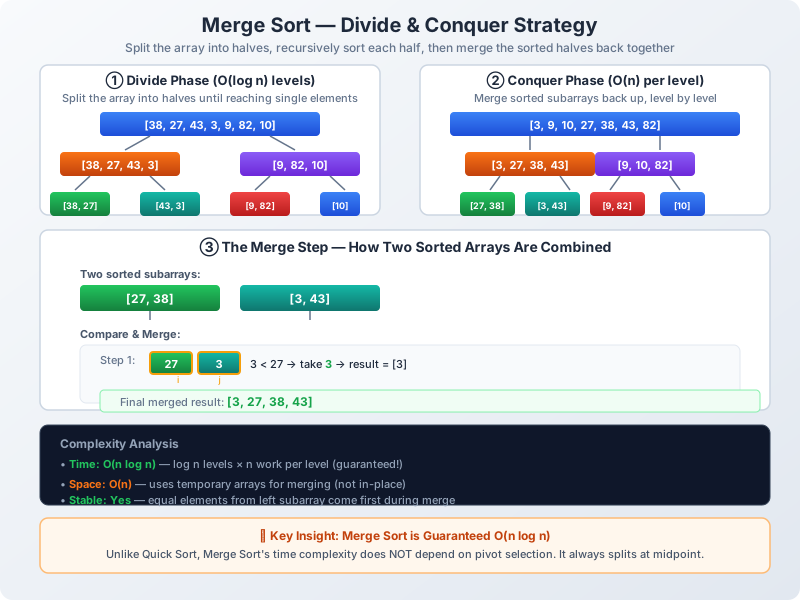
Visual Walkthrough — Full Recursion Tree
Section titled “Visual Walkthrough — Full Recursion Tree”Sort: [38, 27, 43, 3, 9, 82, 10]
flowchart TD    L0["[38, 27, 43, 3, 9, 82, 10]"]    L1_L["[38, 27, 43, 3]"]    L1_R["[9, 82, 10]"]    L2_LL["[38, 27]"]    L2_LR["[43, 3]"]    L2_RL["[9, 82]"]    L2_RR["[10]"]    L3_LLL["[38]"]    L3_LLR["[27]"]    L3_LRL["[43]"]    L3_LRR["[3]"]    L3_RLL["[9]"]    L3_RLR["[82]"]
    M2_LL["[27, 38]"]    M2_LR["[3, 43]"]    M2_RL["[9, 82]"]    M1_L["[3, 27, 38, 43]"]    M1_R["[9, 10, 82]"]    RESULT["[3, 9, 10, 27, 38, 43, 82] ✅"]
    L0 --> L1_L    L0 --> L1_R    L1_L --> L2_LL    L1_L --> L2_LR    L1_R --> L2_RL    L1_R --> L2_RR    L2_LL --> L3_LLL    L2_LL --> L3_LLR    L2_LR --> L3_LRL    L2_LR --> L3_LRR    L2_RL --> L3_RLL    L2_RL --> L3_RLR
    L3_LLL & L3_LLR --> M2_LL    L3_LRL & L3_LRR --> M2_LR    L3_RLL & L3_RLR --> M2_RL    M2_LL & M2_LR --> M1_L    M2_RL & L2_RR --> M1_R    M1_L & M1_R --> RESULT
    style RESULT fill:#059669,color:#fff    style L0 fill:#7c3aed,color:#fff    style M1_L fill:#4f46e5,color:#fff    style M1_R fill:#4f46e5,color:#fff
Level 0 (Divide): [38, 27, 43, 3, 9, 82, 10] / \Level 1: [38, 27, 43, 3] [9, 82, 10] / \ / \Level 2: [38, 27] [43, 3] [9, 82] [10] / \ / \ / \ |Level 3: [38] [27] [43] [3] [9] [82] [10] ↘ ↙ ↘ ↙ ↘ ↙ |Level 2: [27, 38] [3, 43] [9, 82] [10] ↘ ↙ ↘ ↙Level 1: [3, 27, 38, 43] [9, 10, 82] ↘ ↙Level 0: [3, 9, 10, 27, 38, 43, 82] ✅ SORTED!The Merge Process — Detailed
Section titled “The Merge Process — Detailed”The merge step is the heart of Merge Sort. It takes two already-sorted arrays and combines them into one sorted array.
Merge: [27, 38] + [3, 43] → [3, 27, 38, 43]
Step 1: Compare left[0]=27 vs right[0]=3        3 < 27 → take 3    → result = [3]        left = [27, 38], right = [43]
Step 2: Compare left[0]=27 vs right[0]=43        27 < 43 → take 27   → result = [3, 27]        left = [38], right = [43]
Step 3: Compare left[0]=38 vs right[0]=43        38 < 43 → take 38   → result = [3, 27, 38]        left = [], right = [43]
Step 4: Left is empty → copy remaining right        take 43 → result = [3, 27, 38, 43] ✅
🔹 JavaScript Implementation
Section titled “🔹 JavaScript Implementation”// Merge function: combines two sorted arrays into one sorted arrayfunction merge(left, right) { const result = []; let i = 0, j = 0;
// Compare elements from both arrays and take the smaller one while (i < left.length && j < right.length) { if (left[i] <= right[j]) { result.push(left[i]); i++; } else { result.push(right[j]); j++; } }
// Add remaining elements from the non-empty array // (at most one of these loops will execute) while (i < left.length) { result.push(left[i]); i++; }
while (j < right.length) { result.push(right[j]); j++; }
return result;}
// Merge Sort: recursive divide-and-conquerfunction mergeSort(arr) { // Base case: arrays with 0 or 1 element are already sorted if (arr.length <= 1) { return arr; }
// Divide: split the array into two halves const mid = Math.floor(arr.length / 2); const left = arr.slice(0, mid); const right = arr.slice(mid);
// Conquer: recursively sort both halves // Combine: merge the sorted halves return merge(mergeSort(left), mergeSort(right));}
// Testconsole.log(mergeSort([38, 27, 43, 3, 9, 82, 10]));// Output: [3, 9, 10, 27, 38, 43, 82]
console.log(mergeSort([64, 34, 25, 12, 22, 11, 90]));// Output: [11, 12, 22, 25, 34, 64, 90]🔹 In-Place Merge (No Extra Array Creation)
Section titled “🔹 In-Place Merge (No Extra Array Creation)”The version above creates new arrays with slice(), which can be memory-intensive. An in-place merge reduces memory overhead:
function mergeInPlace(arr, left, mid, right) {    // Create temporary arrays for left and right halves    const leftLen = mid - left + 1;    const rightLen = right - mid;
    const leftArr = arr.slice(left, mid + 1);    const rightArr = arr.slice(mid + 1, right + 1);
    let i = 0, j = 0, k = left;
    // Merge back into original array    while (i < leftLen && j < rightLen) {        if (leftArr[i] <= rightArr[j]) {            arr[k] = leftArr[i];            i++;        } else {            arr[k] = rightArr[j];            j++;        }        k++;    }
    // Copy remaining elements    while (i < leftLen) {        arr[k] = leftArr[i];        i++;        k++;    }
    while (j < rightLen) {        arr[k] = rightArr[j];        j++;        k++;    }}
function mergeSortInPlace(arr, left = 0, right = arr.length - 1) {    if (left < right) {        const mid = Math.floor((left + right) / 2);        mergeSortInPlace(arr, left, mid);        mergeSortInPlace(arr, mid + 1, right);        mergeInPlace(arr, left, mid, right);    }    return arr;}
// Testconst arr = [38, 27, 43, 3, 9, 82, 10];console.log(mergeSortInPlace(arr));// Output: [3, 9, 10, 27, 38, 43, 82]
🔹 Descending Order
Section titled “🔹 Descending Order”function mergeDescending(left, right) { const result = []; let i = 0, j = 0;
while (i < left.length && j < right.length) { if (left[i] >= right[j]) { // ← Change to >= for descending result.push(left[i]); i++; } else { result.push(right[j]); j++; } }
while (i < left.length) result.push(left[i++]); while (j < right.length) result.push(right[j++]);
return result;}
function mergeSortDescending(arr) { if (arr.length <= 1) return arr;
const mid = Math.floor(arr.length / 2); const left = mergeSortDescending(arr.slice(0, mid)); const right = mergeSortDescending(arr.slice(mid));
return mergeDescending(left, right);}
console.log(mergeSortDescending([38, 27, 43, 3, 9, 82, 10]));// Output: [82, 43, 38, 27, 10, 9, 3]🔹 Bottom-Up (Iterative) Merge Sort
Section titled “🔹 Bottom-Up (Iterative) Merge Sort”The recursive version is intuitive but uses O(log n) stack space. We can implement Merge Sort iteratively — merging progressively larger subarrays:
function mergeSortIterative(arr) {    const n = arr.length;
    // Start with subarrays of size 1, double each iteration    for (let size = 1; size < n; size *= 2) {        // Merge subarrays of current size        for (let leftStart = 0; leftStart < n; leftStart += 2 * size) {            const mid = Math.min(leftStart + size - 1, n - 1);            const rightEnd = Math.min(leftStart + 2 * size - 1, n - 1);
            if (mid < rightEnd) {                mergeInPlace(arr, leftStart, mid, rightEnd);            }        }    }
    return arr;}
// Testconsole.log(mergeSortIterative([38, 27, 43, 3, 9, 82, 10]));// Output: [3, 9, 10, 27, 38, 43, 82]
Visual: Bottom-up Merge Sort (size doubles each round)
Initial: [38, 27, 43, 3, 9, 82, 10]
size=1: [27, 38] [3, 43] [9, 82] [10] └── merge adjacent 1-element arrays ──┘
size=2: [3, 27, 38, 43] [9, 10, 82] └── merge adjacent 2-element arrays ──┘
size=4: [3, 9, 10, 27, 38, 43, 82] └── merge adjacent 4-element arrays ──┘🔹 Sorting Objects
Section titled “🔹 Sorting Objects”function mergeByKey(arr, key) { if (arr.length <= 1) return arr;
const mid = Math.floor(arr.length / 2); const left = mergeByKey(arr.slice(0, mid), key); const right = mergeByKey(arr.slice(mid), key);
const result = []; let i = 0, j = 0;
while (i < left.length && j < right.length) { if (left[i][key] <= right[j][key]) { result.push(left[i]); i++; } else { result.push(right[j]); j++; } }
return [...result, ...left.slice(i), ...right.slice(j)];}
const students = [ { name: 'Alice', score: 85 }, { name: 'Bob', score: 72 }, { name: 'Carol', score: 91 }, { name: 'Dave', score: 68 }];
console.log(mergeByKey(students, 'score'));// Output: sorted by score ascending📊 Time & Space Complexity
Section titled “📊 Time & Space Complexity”| Case | Time Complexity | Explanation |
|---|---|---|
| Best Case | O(n log n) | Always splits into halves regardless of input order |
| Average Case | O(n log n) | Same number of comparisons regardless of input |
| Worst Case | O(n log n) | Guaranteed — Merge Sort never degrades to O(n²) |
| Space (Recursive) | O(n) auxiliary + O(log n) stack | Need temp arrays for merging |
| Space (Iterative) | O(n) auxiliary | No recursion stack overhead |
Why O(n log n)?
Section titled “Why O(n log n)?”Level 0: 1 array of size n → n comparisons to mergeLevel 1: 2 arrays of size n/2 → 2×(n/2) = n comparisons to mergeLevel 2: 4 arrays of size n/4 → 4×(n/4) = n comparisons to merge...Level k: n arrays of size 1 → n×(1) = n comparisons to merge
Number of levels = log₂(n)Work per level = O(n)Total = O(n log n)Merge Sort vs Other O(n log n) Sorts
Section titled “Merge Sort vs Other O(n log n) Sorts”| Algorithm | Time (All Cases) | Space | Stable | Cache Performance |
|---|---|---|---|---|
| Merge Sort | O(n log n) guaranteed | O(n) | ✅ Yes | Good (sequential access) |
| Quick Sort | O(n log n) avg, O(n²) worst | O(log n) | ❌ No | Excellent |
| Heap Sort | O(n log n) guaranteed | O(1) | ❌ No | Poor (random access) |
🔹 Stability
Section titled “🔹 Stability”Merge Sort is stable. When merging, the condition left[i] <= right[j] ensures that equal elements from the left subarray are placed in the result before equal elements from the right subarray. Since elements in the left subarray originally came before elements in the right subarray, their relative order is preserved.
// Use <= for stabilityif (left[i] <= right[j])  // ✅ STABLE — equal elements from left come first    result.push(left[i]);
// Use < for instabilityif (left[i] < right[j])   // ❌ UNSTABLE — equal elements from right come first    result.push(left[i]);
🔹 Properties Summary
Section titled “🔹 Properties Summary”| Property | Value |
|---|---|
| Time (Best) | O(n log n) |
| Time (Average) | O(n log n) |
| Time (Worst) | O(n log n) — guaranteed! |
| Space | O(n) auxiliary |
| Stable | ✅ Yes |
| In-Place | ❌ No (requires O(n) extra space) |
| Adaptive | ❌ No (always O(n log n)) |
| Online | ❌ No (requires full array) |
| Approach | Divide & Conquer |
| Recursive | ✅ Yes (can be iterative) |
🎯 When to Use Merge Sort
Section titled “🎯 When to Use Merge Sort”Use Merge Sort When:
Section titled “Use Merge Sort When:”- You need guaranteed O(n log n) performance regardless of input
- Stability is important (equal elements must maintain relative order)
- You’re sorting linked lists — Merge Sort works naturally with sequential access
- The data is stored on external storage (disk, tape) — sequential merge is ideal
- You’re performing external sorting (sorting data too large for memory)
Do NOT Use When:
Section titled “Do NOT Use When:”- Memory is constrained — O(n) extra space is required
- In-place sorting is required
- The dataset is small (Insertion Sort is faster for n < 30–50)
- Constant factors matter more than asymptotic guarantees
Real-World Usage
Section titled “Real-World Usage”Merge Sort is widely used:
- Python’s
sorted()and.sort()— uses TimSort (hybrid of Merge Sort + Insertion Sort) - JavaScript’s
.sort()— V8 uses TimSort since 2019 - Java’s
Arrays.sort(Object[])— uses TimSort - External sorting — sorting large files on disk
- Linked list sorting — Merge Sort’s sequential access pattern is ideal
- Inversion counting — a classic algorithm problem (count how far an array is from being sorted)
🔹 Counting Inversions with Merge Sort
Section titled “🔹 Counting Inversions with Merge Sort”Merge Sort’s merge step naturally reveals inversions — pairs of elements that are out of order.
function countInversions(arr) {    let count = 0;
    function mergeCount(left, right) {        const result = [];        let i = 0, j = 0;
        while (i < left.length && j < right.length) {            if (left[i] <= right[j]) {                result.push(left[i]);                i++;            } else {                // left[i] > right[j] — this is an inversion!                // All remaining elements in left are > right[j]                count += left.length - i;                result.push(right[j]);                j++;            }        }
        return [...result, ...left.slice(i), ...right.slice(j)];    }
    function sort(arr) {        if (arr.length <= 1) return arr;        const mid = Math.floor(arr.length / 2);        return mergeCount(sort(arr.slice(0, mid)), sort(arr.slice(mid)));    }
    sort(arr);    return count;}
console.log(countInversions([2, 4, 1, 3, 5]));// Output: 3// Inversions: (2,1), (4,1), (4,3)
console.log(countInversions([5, 4, 3, 2, 1]));// Output: 10  (completely reversed — max inversions = n(n-1)/2)
💡 Interview Tips
Section titled “💡 Interview Tips”“Why is Merge Sort O(n log n)?” — The array is divided log n times (splitting in half). At each of the log n levels, merging takes O(n) work. Total: O(n log n). This is a guaranteed bound, unlike Quick Sort.
“Is Merge Sort stable? How do you ensure stability?” — Yes. Use
<=instead of<when comparing elements during the merge. This ensures equal elements from the left subarray (which appear first in the original order) are placed before equal elements from the right subarray.
“What is the space complexity of Merge Sort?” — O(n) auxiliary space for the temporary arrays during merging. The recursive version also uses O(log n) call stack space, but that’s typically not counted in auxiliary space analysis.
“Merge Sort vs Quick Sort?” — Merge Sort guarantees O(n log n) and is stable but uses O(n) space. Quick Sort is faster in practice (better cache locality), in-place, but has O(n²) worst case and is unstable.
“Can Merge Sort be done in-place?” — Yes, but the implementations are complex and rarely used in practice. The standard in-place merge technique has a higher constant factor that often negates the memory benefit.
“Why does Merge Sort work well for linked lists?” — Linked lists don’t support random access, but Merge Sort only requires sequential access (linear traversal). No extra space is needed for linked lists because elements can be re-linked instead of copying.
Next: Quick Sort →