
Quick Sort
Quick Sort
Section titled “Quick Sort”🎯 What Is Quick Sort?
Section titled “🎯 What Is Quick Sort?”Quick Sort is a divide-and-conquer algorithm that picks a pivot element, partitions the array so that smaller elements go left and larger elements go right, then recursively sorts both sides.
Core idea: Choose a pivot. Place everything smaller than the pivot on the left and everything larger on the right. The pivot is now in its final position. Repeat for the left and right partitions.
🔹 How It Works — Step by Step
Section titled “🔹 How It Works — Step by Step”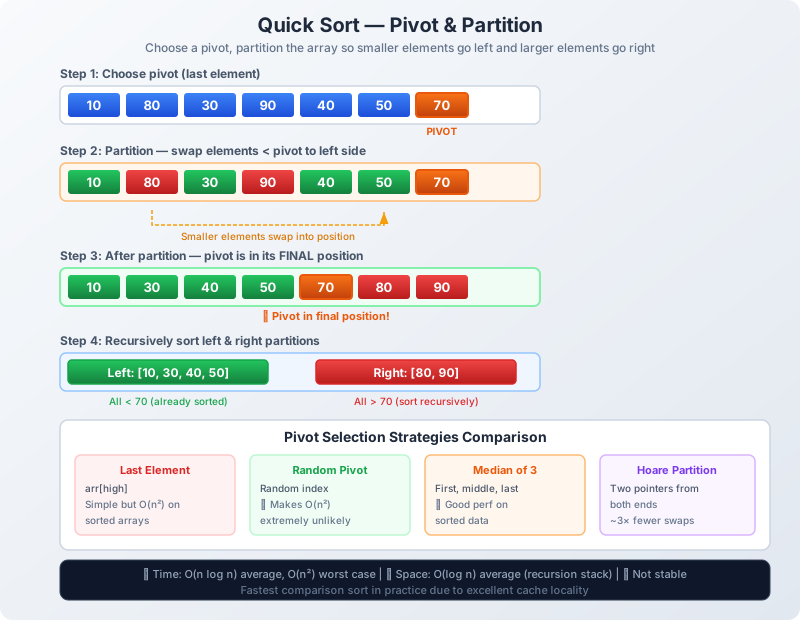
Visual Walkthrough
Section titled “Visual Walkthrough”Sort: [10, 80, 30, 90, 40, 50, 70] with pivot = last element (70)
Initial: [10, 80, 30, 90, 40, 50, 70]                                      ↑                                   pivot=70
─────────────────────────────────────────Partition: Place pivot 70 in its correct position─────────────────────────────────────────[10, 80, 30, 90, 40, 50, 70]  ↑  i=0 (partition boundary starts at 0)
Compare 10 ≤ 70 → swap with itself → i=1Compare 80 > 70 → skip (don't move)Compare 30 ≤ 70 → swap with 80 → i=2  → [10, 30, 80, 90, 40, 50, 70]Compare 90 > 70 → skipCompare 40 ≤ 70 → swap with 80 → i=3  → [10, 30, 40, 90, 80, 50, 70]Compare 50 ≤ 70 → swap with 90 → i=4  → [10, 30, 40, 50, 80, 90, 70]
Final swap pivot (70) with position i=4:[10, 30, 40, 50, 70, 90, 80]                ↑           pivot is now in its FINAL position ✅
─────────────────────────────────────────Recursively sort left partition [10, 30, 40, 50]─────────────────────────────────────────Pivot = 50[10, 30, 40, 50]              ↑Partition: only 50 is in position, left all smaller[10, 30, 40, 50]  →  sort [10, 30, 40] next
─────────────────────────────────────────Recursively sort right partition [90, 80]─────────────────────────────────────────Pivot = 80[90, 80]     ↑Compare 90 > 80 → skip (90 belongs on right of pivot)All remaining elements processedSwap pivot into position: [80, 90]
─────────────────────────────────────────Finally sorted: [10, 30, 40, 50, 70, 80, 90] ✅
The Partition Process (Lomuto) — Animated
Section titled “The Partition Process (Lomuto) — Animated”Start: [10, 80, 30, 90, 40, 50, 70] ↑ ↑ i (first larger) pivot
Step 1: 10 ≤ 70 → swap arr[i] with arr[i], i=1 [10, 80, 30, 90, 40, 50, 70] ↑ i
Step 2: 80 > 70 → skip, i stays at 80
Step 3: 30 ≤ 70 → swap 80↔30, i=2 [10, 30, 80, 90, 40, 50, 70] ↑ i
Step 4: 90 > 70 → skip
Step 5: 40 ≤ 70 → swap 80↔40, i=3 [10, 30, 40, 90, 80, 50, 70] ↑ i
Step 6: 50 ≤ 70 → swap 90↔50, i=4 [10, 30, 40, 50, 80, 90, 70] ↑ i
Final: swap pivot (70) with arr[4] [10, 30, 40, 50, 70, 90, 80] ↑ pivot in final position ✅🔹 JavaScript Implementation — Lomuto Partition
Section titled “🔹 JavaScript Implementation — Lomuto Partition”The Lomuto partition scheme is simpler to understand but slightly less efficient.
function partitionLomuto(arr, low, high) {    const pivot = arr[high];  // Choose last element as pivot    let i = low;              // Index where pivot will go
    for (let j = low; j < high; j++) {        // If current element is ≤ pivot, swap it to the left side        if (arr[j] <= pivot) {            [arr[i], arr[j]] = [arr[j], arr[i]];            i++;        }    }
    // Place pivot in its final position    [arr[i], arr[high]] = [arr[high], arr[i]];    return i;  // Return pivot index}
function quickSortLomuto(arr, low = 0, high = arr.length - 1) {    if (low < high) {        // Partition the array and get pivot index        const pivotIndex = partitionLomuto(arr, low, high);
        // Recursively sort elements before and after pivot        quickSortLomuto(arr, low, pivotIndex - 1);        quickSortLomuto(arr, pivotIndex + 1, high);    }
    return arr;}
// Testconsole.log(quickSortLomuto([10, 80, 30, 90, 40, 50, 70]));// Output: [10, 30, 40, 50, 70, 80, 90]
console.log(quickSortLomuto([64, 34, 25, 12, 22, 11, 90]));// Output: [11, 12, 22, 25, 34, 64, 90]
🔹 Hoare Partition (More Efficient)
Section titled “🔹 Hoare Partition (More Efficient)”The Hoare partition scheme uses two pointers moving from both ends toward the middle. It makes ~3× fewer swaps on average than Lomuto.
function partitionHoare(arr, low, high) {    const pivot = arr[Math.floor((low + high) / 2)];  // Middle element as pivot    let i = low - 1;    let j = high + 1;
    while (true) {        // Find element on left that should be on right        do { i++; } while (arr[i] < pivot);
        // Find element on right that should be on left        do { j--; } while (arr[j] > pivot);
        // Pointers crossed → partition done        if (i >= j) return j;
        // Swap the out-of-place elements        [arr[i], arr[j]] = [arr[j], arr[i]];    }}
function quickSortHoare(arr, low = 0, high = arr.length - 1) {    if (low < high) {        const pivotIndex = partitionHoare(arr, low, high);
        // Note: Hoare returns the split point, not the pivot's final position        // Both sides include the pivot element        quickSortHoare(arr, low, pivotIndex);        quickSortHoare(arr, pivotIndex + 1, high);    }
    return arr;}
// Testconsole.log(quickSortHoare([10, 80, 30, 90, 40, 50, 70]));// Output: [10, 30, 40, 50, 70, 80, 90]
Lomuto vs Hoare Comparison
Section titled “Lomuto vs Hoare Comparison”| Aspect | Lomuto Partition | Hoare Partition |
|---|---|---|
| Simplicity | ✅ Simpler to understand | ❌ More complex |
| Swaps | ~n swaps per partition | ~n/3 swaps per partition |
| Performance | ~3× slower than Hoare | Faster in practice |
| Pivot choice | Usually last element | Usually middle element |
| Return value | Pivot’s final position | Split point (not pivot) |
| Use case | Educational, easy-to-read | Production code |
🔹 Pivot Selection Strategies
Section titled “🔹 Pivot Selection Strategies”1. Last Element (Lomuto default)
Section titled “1. Last Element (Lomuto default)”const pivot = arr[high];// Simple but worst-case on already sorted arraysProblem: If the array is already sorted, the pivot is the largest element, creating very unbalanced partitions.
2. First Element
Section titled “2. First Element”const pivot = arr[low];// Same problem as last element3. Random Pivot (Best for average performance)
Section titled “3. Random Pivot (Best for average performance)”function partitionRandom(arr, low, high) { // Swap a random element with the last element const randomIndex = low + Math.floor(Math.random() * (high - low + 1)); [arr[randomIndex], arr[high]] = [arr[high], arr[randomIndex]];
// Now use standard Lomuto with last element as pivot const pivot = arr[high]; let i = low;
for (let j = low; j < high; j++) { if (arr[j] <= pivot) { [arr[i], arr[j]] = [arr[j], arr[i]]; i++; } }
[arr[i], arr[high]] = [arr[high], arr[i]]; return i;}Benefit: Makes O(n²) worst-case extremely unlikely (probability → 0 for large n).
4. Median-of-Three
Section titled “4. Median-of-Three”function medianOfThree(arr, low, high) { const mid = Math.floor((low + high) / 2);
// Sort low, mid, high (bubble sort style) if (arr[low] > arr[mid]) [arr[low], arr[mid]] = [arr[mid], arr[low]]; if (arr[low] > arr[high]) [arr[low], arr[high]] = [arr[high], arr[low]]; if (arr[mid] > arr[high]) [arr[mid], arr[high]] = [arr[high], arr[mid]];
// Place median (mid) at high-1 and use as pivot [arr[mid], arr[high - 1]] = [arr[high - 1], arr[mid]]; return arr[high - 1];}Benefit: Guarantees against worst-case on sorted arrays. The median of three is always a reasonable pivot.
🔹 Optimized Quick Sort
Section titled “🔹 Optimized Quick Sort”Combines several optimizations: random pivot, switch to Insertion Sort for small subarrays, and tail-call optimization.
function quickSortOptimized(arr, low = 0, high = arr.length - 1) {    // Switch to Insertion Sort for small subarrays    if (high - low < 10) {        insertionSortRange(arr, low, high);        return arr;    }
    while (low < high) {        const pivotIndex = partitionRandom(arr, low, high);
        // Tail recursion optimization: always recurse on smaller partition        if (pivotIndex - low < high - pivotIndex) {            quickSortOptimized(arr, low, pivotIndex - 1);            low = pivotIndex + 1;  // Process larger partition iteratively        } else {            quickSortOptimized(arr, pivotIndex + 1, high);            high = pivotIndex - 1;  // Process larger partition iteratively        }    }
    return arr;}
function insertionSortRange(arr, low, high) {    for (let i = low + 1; i <= high; i++) {        const key = arr[i];        let j = i - 1;        while (j >= low && arr[j] > key) {            arr[j + 1] = arr[j];            j--;        }        arr[j + 1] = key;    }}
// Testconst testArr = Array.from({ length: 100 }, () => Math.floor(Math.random() * 1000));console.log(quickSortOptimized(testArr));// Correctly sorted ✅
// Performance comparisonconst n = 10000;const arr1 = Array.from({ length: n }, () => Math.random());const arr2 = [...arr1];
console.time('Basic Quick Sort');quickSortLomuto(arr1);console.timeEnd('Basic Quick Sort');
console.time('Optimized Quick Sort');quickSortOptimized(arr2);console.timeEnd('Optimized Quick Sort');
// On random data, optimized version is 2-3× faster
🔹 Descending Order
Section titled “🔹 Descending Order”function partitionDescending(arr, low, high) { const pivot = arr[high]; let i = low;
for (let j = low; j < high; j++) { if (arr[j] >= pivot) { // ← Change to >= for descending [arr[i], arr[j]] = [arr[j], arr[i]]; i++; } }
[arr[i], arr[high]] = [arr[high], arr[i]]; return i;}
function quickSortDescending(arr, low = 0, high = arr.length - 1) { if (low < high) { const pivotIndex = partitionDescending(arr, low, high); quickSortDescending(arr, low, pivotIndex - 1); quickSortDescending(arr, pivotIndex + 1, high); } return arr;}
console.log(quickSortDescending([10, 80, 30, 90, 40, 50, 70]));// Output: [90, 80, 70, 50, 40, 30, 10]📊 Time & Space Complexity
Section titled “📊 Time & Space Complexity”| Case | Time Complexity | Explanation |
|---|---|---|
| Best Case | O(n log n) | Pivot always splits array into equal halves |
| Average Case | O(n log n) | Random pivot gives balanced partitions |
| Worst Case | O(n²) | Pivot is min or max every time (sorted array with bad pivot) |
| Space (Lomuto) | O(n) worst, O(log n) avg | Call stack for recursion |
Why O(n²) Worst Case?
Section titled “Why O(n²) Worst Case?”When the pivot is always the smallest or largest element (e.g., sorted array with first/last element pivot):
Sorted array: [1, 2, 3, 4, 5, 6, 7, 8]
Pivot = last element = 8Left partition: [1, 2, 3, 4, 5, 6, 7]  (size n-1)Right partition: []                     (size 0)
Next pivot = 7Left: [1, 2, 3, 4, 5, 6]  (size n-2)
Total work: n + (n-1) + (n-2) + ... + 1 = O(n²)
This is why random pivot or median-of-three are essential in practice.
Why O(n log n) Average?
Section titled “Why O(n log n) Average?”On average, random pivots create reasonably balanced partitions:
Level 0: n elementsLevel 1: ~n/2 + ~n/2    → total nLevel 2: ~n/4 × 4       → total n...Level log n: ~1 × n     → total n
Work per level = O(n)Number of levels = O(log n) on averageTotal = O(n log n)
🔹 Is Quick Sort Stable?
Section titled “🔹 Is Quick Sort Stable?”No — Quick Sort is unstable. The partition step can swap equal elements across long distances, breaking their relative order.
// Example: Sort by score ascending// Original: [(Alice,70), (Bob,50), (Carol,70)]
// After partition with pivot = last (Carol,70):// (Bob,50) goes left, (Carol,70) goes to pivot position// (Alice,70) ends up on the right side of (Carol,70)!// Result: [(Bob,50), (Carol,70), (Alice,70)] — Carol before Alice ❌
🔹 Properties Summary
Section titled “🔹 Properties Summary”| Property | Value |
|---|---|
| Time (Best) | O(n log n) — balanced partitions |
| Time (Average) | O(n log n) |
| Time (Worst) | O(n²) — unbalanced partitions |
| Space (Average) | O(log n) — recursion stack |
| Space (Worst) | O(n) — if recursion depth = n |
| Stable | ❌ No |
| In-Place | ✅ Yes (if recursion stack is discounted) |
| Adaptive | ❌ No |
| Approach | Divide & Conquer |
🎯 When to Use Quick Sort
Section titled “🎯 When to Use Quick Sort”Use Quick Sort When:
Section titled “Use Quick Sort When:”- Average-case performance matters most (very fast in practice)
- Memory is constrained — O(log n) space on average
- The input is random and unpredictable
- You need the fastest comparison sort for in-memory arrays
- Cache performance is important (sequential access to partition)
Do NOT Use When:
Section titled “Do NOT Use When:”- Guaranteed worst-case performance is required (use Merge Sort or Heap Sort)
- Stability is required
- The input is known to be sorted or nearly sorted (without random pivot)
- Working with linked lists (sequential access doesn’t suit partitioning)
Real-World Usage
Section titled “Real-World Usage”Quick Sort is the most widely used sorting algorithm in practice:
- C’s
qsort()— uses Quick Sort (often with median-of-three) - Java’s
Arrays.sort(int[])— uses Dual-Pivot Quick Sort - STL’s
std::sort()— IntroSort (Quick Sort + Heap Sort fallback) - Most standard library sort implementations for primitive types
- Database query optimizers — sorting intermediate results
🔹 Quick Select — A Related Algorithm
Section titled “🔹 Quick Select — A Related Algorithm”Quick Select uses Quick Sort’s partition to find the k-th smallest element in O(n) average time without fully sorting.
function quickSelect(arr, k) {    function select(low, high) {        if (low === high) return arr[low];
        const pivotIndex = partitionRandom(arr, low, high);
        if (k === pivotIndex) {            return arr[k];        } else if (k < pivotIndex) {            return select(low, pivotIndex - 1);        } else {            return select(pivotIndex + 1, high);        }    }
    return select(0, arr.length - 1);}
const nums = [7, 10, 4, 3, 20, 15];console.log(quickSelect(nums, 3));    // 3rd smallest (0-indexed)// Output: 10// Sorted: [3, 4, 7, 10, 15, 20] → index 3 = 10
Time Complexity: O(n) average, O(n²) worst case — same tradeoffs as Quick Sort.
💡 Interview Tips
Section titled “💡 Interview Tips”“Explain Quick Sort in one sentence.” — Pick a pivot, partition the array so smaller elements go left and larger elements go right, then recursively sort both partitions.
“What is Quick Sort’s worst case and how do you avoid it?” — O(n²) when the pivot is always the min or max. Avoid by using a random pivot or median-of-three pivot selection.
“Lomuto vs Hoare partition — which is better?” — Hoare makes ~3× fewer swaps and is faster in practice. Lomuto is simpler to understand and teach.
“Why is Quick Sort faster than Merge Sort in practice?” — Better cache locality (sequential access during partition), in-place sorting (less memory allocation), and lower constant factors.
“Is Quick Sort stable?” — No. The partition process swaps elements across the array in a way that can break the relative order of equal elements.
“What is IntroSort?” — A hybrid that starts with Quick Sort but switches to Heap Sort if recursion depth exceeds log n. This guarantees O(n log n) worst-case while keeping Quick Sort’s average-case speed.
Next: Heap Sort →