
Understanding the Call Stack
Understanding the Call Stack
Section titled “Understanding the Call Stack”How Function Calls Are Stored
Section titled “How Function Calls Are Stored”When any function is called (not just recursive ones), the computer:
- Creates a “stack frame” — a block of memory holding:
- The function’s local variables
- The arguments passed
- The return address (where to go back to when done)
- Pushes this frame onto the call stack
- When the function returns, its frame is popped off the stack
flowchart TD    subgraph Stack[Call Stack - LIFO]        direction TB        F4["factorial(1)\nreturns 1"]        F3["factorial(2)\n2 × ?"]        F2["factorial(3)\n3 × ?"]        F1["factorial(4)\n4 × ?"]    end
    F4 --> F3 --> F2 --> F1
    style F4 fill:#7c3aed,color:#fff    style F3 fill:#4f46e5,color:#fff    style F2 fill:#4f46e5,color:#fff    style F1 fill:#6366f1,color:#fff
The Call Stack is a LIFO (Last In, First Out) data structure.
Think of it like a stack of cafeteria trays: - You can only add/remove from the TOP - The last tray put on top is the first one taken off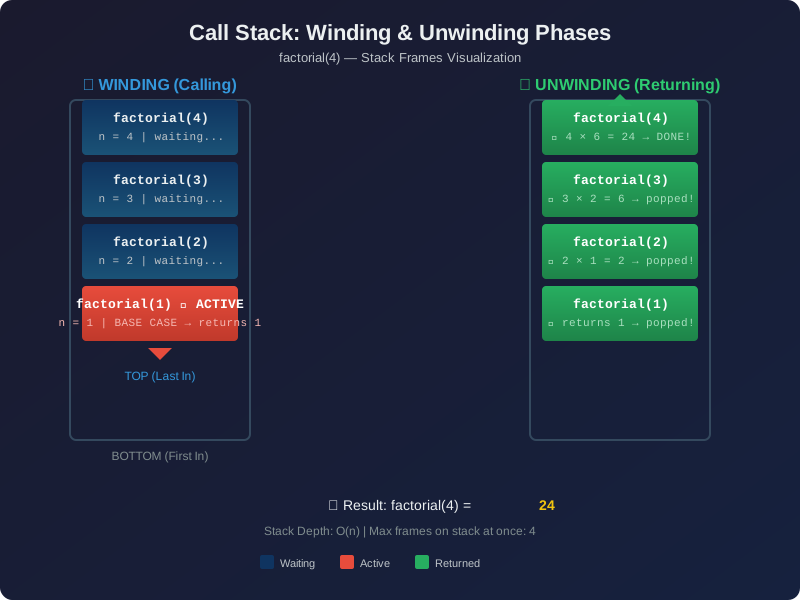
Detailed Visual Dry Run
Section titled “Detailed Visual Dry Run”Let’s trace factorial(4):
function factorial(n) { if (n <= 1) return 1; // Base case return n * factorial(n - 1); // Recursive case}Phase 1: WINDING (Going Deeper)
Section titled “Phase 1: WINDING (Going Deeper)”Call: factorial(4) → 4 * factorial(3) // doesn't know factorial(3) yet, must compute
Call: factorial(3) → 3 * factorial(2) // doesn't know factorial(2) yet, must compute
Call: factorial(2) → 2 * factorial(1) // doesn't know factorial(1) yet, must compute
Call: factorial(1) → returns 1 // BASE CASE HIT!Stack at deepest point:
┌────────────────────────────┐ │ factorial(1) → returns 1 │ ← TOP ├────────────────────────────┤ │ factorial(2) → 2 * ??? │ ├────────────────────────────┤ │ factorial(3) → 3 * ??? │ ├────────────────────────────┤ │ factorial(4) → 4 * ??? │ └────────────────────────────┘ BOTTOM (first call)Phase 2: UNWINDING (Coming Back Up)
Section titled “Phase 2: UNWINDING (Coming Back Up)”factorial(1) returns 1 → factorial(2) now knows: 2 * 1 = 2, returns 2 → factorial(3) now knows: 3 * 2 = 6, returns 6 → factorial(4) now knows: 4 * 6 = 24, returns 24
ANSWER: 24Stack unwinding:
Step A:  factorial(1) returns 1    → popped         ┌────────────────────────────┐         │ factorial(2) → 2 * 1 = 2  │  ← now computable         ├────────────────────────────┤         │ factorial(3) → 3 * ???    │         ├────────────────────────────┤         │ factorial(4) → 4 * ???    │         └────────────────────────────┘
Step B:  factorial(2) returns 2    → popped         ┌────────────────────────────┐         │ factorial(3) → 3 * 2 = 6  │  ← now computable         ├────────────────────────────┤         │ factorial(4) → 4 * ???    │         └────────────────────────────┘
Step C:  factorial(3) returns 6    → popped         ┌────────────────────────────┐         │ factorial(4) → 4 * 6 = 24 │  ← now computable         └────────────────────────────┘
Step D:  factorial(4) returns 24   → popped         ┌────────────────────────────┐         │         (empty)            │         └────────────────────────────┘
RESULT: 24
Stack Overflow
Section titled “Stack Overflow”What happens if there is no base case, or the base case is never reached?
// ⚠️ DANGER: No base case!function infinite(n) { return infinite(n); // calls itself forever}Stack: ┌─────────────┐ │ infinite(5) │ ├─────────────┤ │ infinite(5) │ ├─────────────┤ │ infinite(5) │ ├─────────────┤ │ ... │ ← Stack grows and grows ├─────────────┤ │ infinite(5) │ └─────────────┘
Eventually the stack runs out of memory → CRASH!Error: "Maximum call stack size exceeded" (Stack Overflow)Key rule: Every recursive call MUST make progress toward the base case.
n → n-1 → n-2 → ... → 0 (base case) ✅ Makes progressn → n → n → ... → n (forever) ❌ No progressKey Insights
Section titled “Key Insights”- The winding phase pushes frames onto the stack (going deeper)
- The unwinding phase pops frames off the stack (returning results)
- Code BEFORE the recursive call executes during winding
- Code AFTER the recursive call executes during unwinding
- Stack depth = O(n) for linear recursion — this is why deep recursion can overflow
Next: Types of Recursion →